Location
Citadel Of Wildflowers
 Created by LF_XX_3273
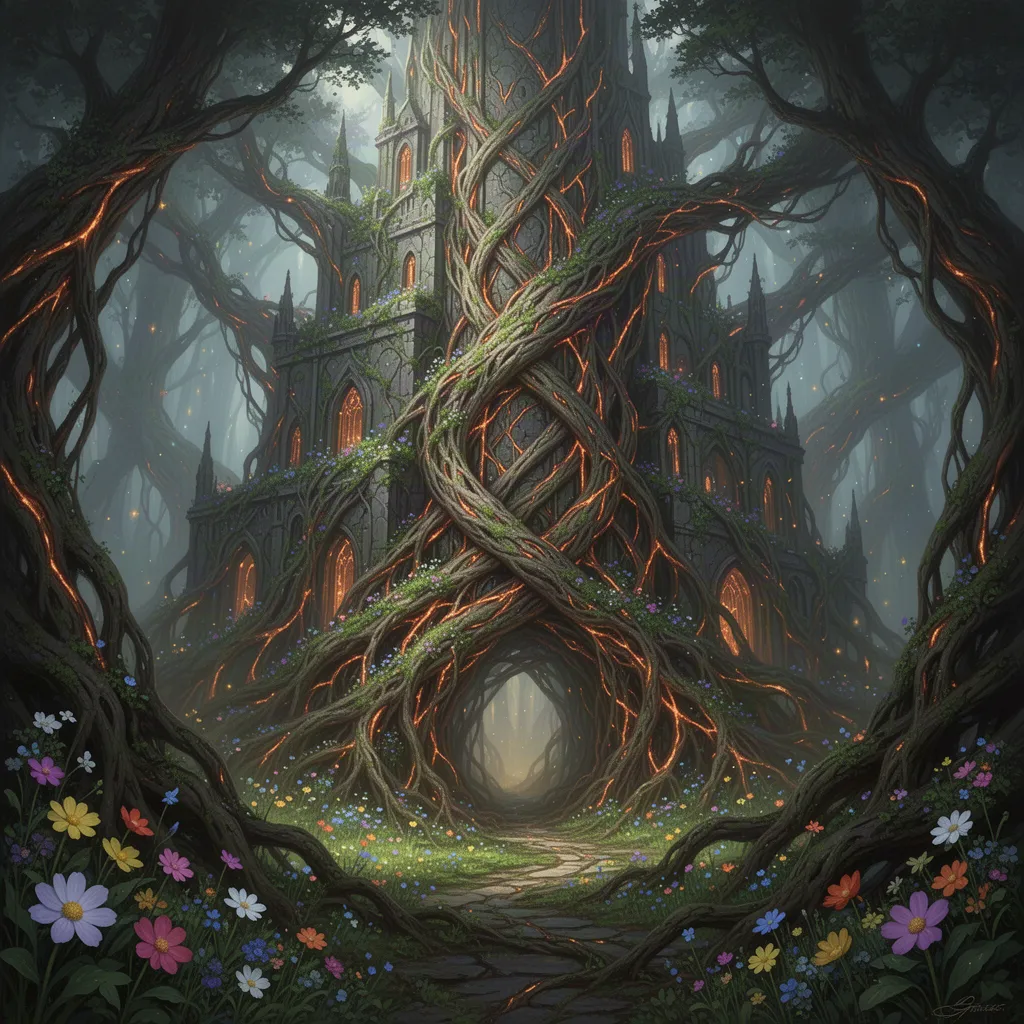
The Citadel of Wildflowers stands as a sprawling fortress of living architecture, where towering root systems have woven themselves into intricate defensive barriers that rival any constructed stone wall, creating a naturally fortified settlement that has earned its name through the sheer biological complexity and stratified organization of its plant communities. Veins of copper run throughout the underlying bedrock and intertwine with the massive root networks, creating a subtle luminescence that pulses with the latent magical energies of the land, though these mana currents serve merely as a secondary phenomenon compared to the raw biological power exerted by centuries of root growth pressing through stone and soil. The citadel sprawls across roughly three square kilometers in an irregular, organic shape that follows the natural contours of water drainage and sunlight exposure, with dense concentrations of wildflowers—comprising approximately sixty percent of the visible flora—intermixed with stands of hardy shrubs, creeping ground covers, climbing vines, and isolated clusters of gnarled trees whose root systems form the structural backbone of this living stronghold. A constant, almost imperceptible vibration resonates through the earth itself, generated by the continuous hydraulic pressure of water moving through the xylem tissues of countless plants and the microscopic fracturing and expansion of roots exploiting fissures in the stone, a phenomenon that creates an audible hum during dawn and dusk when transpiration rates peak. The citadel's designation as such originates from its function as a refuge and gathering point for the countless small creatures of the region—insects, small mammals, amphibians, and countless arthropods—that have established complex ecological communities within the layered plant structures, making it a densely populated settlement despite the complete absence of sentient inhabitants. The copper-veined stone beneath the surface has gradually oxidized over millennia, creating a faint greenish patina visible through gaps in the root systems, while the constant biological activity has shaped the landscape into natural amphitheaters, ridges, and valleys that channel water flow and concentrate nutrient availability in specific zones. No constructed elements exist within the Citadel of Wildflowers, for its very nature as a citadel emerges entirely from the self-organizing principles of plant succession and ecological development, where the plants themselves have become the architects through their relentless, patient work of root penetration, nutrient cycling, and competitive growth over countless generations.
Open in Summon WorldsAt a glance
What this public profile contains
This view-only profile includes a creator-written description; 1 labeled detail field; 1 structured section; 1 artwork image supplied by the creator.
- Creation type
- Location
- Shared by
- LF_XX_3273
- Connected worlds
- 0
- Detail fields
- 1
- Profile sections
- 1
- Artwork images
- 1
Details
- Type
- City
Landmarks
The Mycorrhizal Network Chamber
Situated deep within the citadel's central root mass, this vast underground cavity has been naturally excavated over centuries by the decomposition of organic matter and the selective growth patterns of fungal networks that have colonized the root system, creating a cathedral-like hollow space approximately forty meters in diameter and twenty meters at its highest point. The chamber's walls are entirely composed of densely packed root fibers that have calcified and hardened into a wood-like substance, their surfaces covered in a thin, luminescent mycelial coating that produces a soft blue-green glow, illuminating the space with an ethereal light that pulses in rhythm with the citadel's underground vibrations. Countless thin root filaments hang from the ceiling like organic stalactites, each one serving as a conduit for nutrient distribution and water transport throughout the citadel's upper structures, their surfaces glistening with moisture that drips steadily into shallow pools on the chamber floor, where aquatic plant life has evolved in isolation, creating a miniature ecosystem of water-dwelling ferns and primitive algae species that have adapted to the low-light conditions. The chamber exists as a functional hub within the citadel's biology, serving as a central distribution point where the mycorrhizal fungi break down fallen organic matter and convert it into bioavailable nutrients that are then transported upward through the root network to feed the wildflowers and other vegetation above, making this space essential to the citadel's continued growth and vitality, and the reason it has naturally persisted and expanded rather than being filled in by new root growth is that the fungi actively maintain this space as a processing center, their biological imperative driving them to preserve this cavity for their own metabolic functions.
The Heartwood Confluence
Deep within the citadel's central chamber lies a massive convergence point where the largest primary roots—some as thick as ancient oaks—intersect and fuse together in a complex three-dimensional lattice that rises nearly forty feet toward the canopy above, creating a natural cathedral of interwoven wood and living tissue. The roots at this confluence point display extraordinary biological phenomena: their bark has become translucent in places, revealing the flowing xylem and phloem beneath, which pulse with a rhythmic, almost circulatory motion as nutrients and water are distributed throughout the entire citadel structure. The copper veining is most concentrated here, running through the root tissue like metallic scars, and the mana that saturates this location causes the copper to emit a soft, ethereal luminescence that casts dancing shadows across the chamber walls. Adventurers investigating this landmark would discover that the roots themselves have developed specialized structures—thickened nodes and bulbous protrusions—that serve as nutrient storage organs, allowing the citadel to survive extended periods of drought or seasonal dormancy. The ground surrounding the confluence is carpeted with the densest concentration of wildflowers in the entire citadel, their roots intertwining with the massive primary roots in a symbiotic relationship where the smaller plants benefit from the structural support and nutrient distribution of the larger root system, while simultaneously stabilizing soil and preventing erosion around the base. The vibration that hums through the citadel is most pronounced here, a deep, resonant frequency that seems to originate from the movement of fluids through the vascular tissue and the subtle shifting of the massive roots as they respond to gravitational stress and seasonal growth cycles. This landmark exists as the functional heart of the citadel because it is literally the point where all major root systems converge and communicate throug
Public creation
Worldbuilding Context
Citadel Of Wildflowers is a public location profile shared by LF_XX_3273through Summon Worlds. This view keeps the creator's public information together with clear attribution and links to any connected public Worlds; it does not add story details beyond the fields shown on the profile.
Explore the profile as a standalone creative reference, then open Summon Worlds when you want to connect your own characters, locations, art, and lore inside a living World.
Continue building
Develop the ideas around Citadel Of Wildflowers
Use Citadel Of Wildflowers as a place reference when planning atmosphere, inhabitants, factions, landmarks, conflicts, and the routes that connect a setting. Return to the public fields above as a stable reference, then connect new ideas through a World so collaborators can explore how each creation fits the same shared canon.